
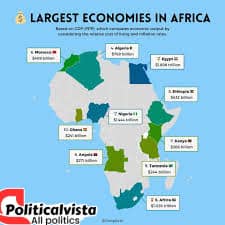
Africa’s economic landscape in 2026 is set to stand out on the global stage as several countries are projected to deliver robust GDP growth despite headwinds such as global uncertainty, debt burdens and trade barriers.
According to multiple economic forecasts, including regional development analysts and growth outlooks, African economies are expected to expand faster than many peers around the world as domestic reforms, commodity exports, infrastructure projects and demographic dividends drive expansion.
In this feature article, we look at the top five fastest-growing African economies in 2026, exploring the drivers behind their performance, the challenges they face, and the wider implications for the continent’s future.
1. South Sudan: A Dramatic Rebound from Ground Zero.
Estimated Growth: ~34.4 %
At the forefront of Africa’s growth rankings in 2026 is South Sudan, with an extraordinary projected GDP expansion of around 34.4 per cent — easily the highest on the continent. This figure reflects a dramatic rebound from years of conflict and economic contraction, driven primarily by the revival of oil production and renewed political stability.
Economists suggest this surge is largely a “base effect” — growth from a very low starting point — yet it signals a remarkable turnaround for a country once mired in civil war. The upturn in output and exports is creating job opportunities, drawing investment and prompting the return of expatriates. While considerable risks remain, including governance challenges and the need for inclusive public services, South Sudan’s rebound underscores the transformational potential of peace and resource-led growth.
2. Senegal: Hydrocarbons and Strategic Investment.
Estimated Growth: ~8.6 %
In West Africa, Senegal is projected to grow by about 8.6 per cent in 2026, placing it firmly among Africa’s fastest-expanding economies. Growth here is underpinned by several strategic sectors: offshore oil and gas production, major infrastructure projects, and resilient agricultural output.
The nation’s economic planners have emphasised diversification — investing in transport, technology, and services — alongside maximising returns from new energy fields. This diversified approach has boosted investor confidence and strengthened fiscal prospects. As one economist notes, “Senegal’s growth is a blend of natural resource gains and smart economic planning that encourages broader participation.”
3. Uganda: Infrastructure and Oil Prospects.
Estimated Growth: ~7.2 %
Uganda heads the next tier of fast-growing economies with an anticipated growth rate of over 7 per cent in 2026. A significant driver of this expansion is investment in infrastructure and transport corridors, which enhances trade logistics and domestic commerce. The anticipated commencement of commercial oil production towards the end of 2026 further strengthens the long-term outlook.
Infrastructure development has also stimulated growth in agriculture, services and regional commerce, positioning Uganda as a key hub within East Africa. According to one analyst, “Uganda’s growth narrative is about connectivity — physically through roads and rails, and economically through diversified production.”
4. Rwanda: Sustained Momentum Through Innovation.
Estimated Growth: ~7.1 %
Rwanda continues to defy expectations with projected growth of around 7.1 per cent in 2026. The country has long pursued a reform-oriented, technology-friendly development model, prioritising investments in tourism, digital services, and public infrastructure.
Unlike many of its peers that lean heavily on extractive industries, Rwanda’s growth is increasingly services-led and innovation-driven, earning it a reputation as a policy laboratory for African reformers. The capital city Kigali remains a magnet for regional talent, while enhanced connectivity and business-friendly regulations continue to attract foreign direct investment.
A Rwandan economic commentator recently observed, “We are building growth not on one sector alone, but across services and innovation pillars that sustain momentum.”
5. Niger: Oil, Infrastructure and Inclusion.
Estimated Growth: ~6.9 %
Rounding out the top five is Niger, with projected GDP growth of nearly 6.9 per cent in 2026. This performance is largely driven by increased hydrocarbon and mining output, alongside government spending on agricultural development and major infrastructure projects that improve regional connectivity.
For landlocked countries like Niger, strategic infrastructure investments — particularly in road networks and logistics — are crucial to unlocking broader economic participation and export opportunities. The government’s focus on expanding agricultural productivity also supports rural incomes and employment, contributing to a more inclusive growth pattern.
As one development economist put it, “Niger’s growth story exemplifies how resource wealth, when coupled with infrastructure expansion and agricultural inclusion, broadens the base of economic participation.”
Beyond the Top Five: A Wider African Growth Landscape
While the headline figures highlight the leaders, several other economies are also charting strong paths:
Benin and Côte d’Ivoire are projected to sustain solid GDP expansions through trade liberalisation, value-added agricultural exports and expanding industrial activity.
Ethiopia, despite facing political and external headwinds, has signalled double-digit growth rates in some assessments due to reforms and expanded hydroelectric and industrial output.
Togo, Djibouti and Zambia also show robust growth prospects, buoyed by logistics, mining and regional trade integration.
These diverse growth patterns suggest that Africa’s economic momentum is not concentrated in a single region but spread across West, East and Central Africa, with both resource-rich and reform-oriented economies playing leading roles.
Drivers Of Africa’s Growth In 2026
Several common forces underlie this projected expansion:
1. Commodity and Energy Exports
Countries with oil, gas and mineral wealth are benefiting from higher global demand and expanded production capacities.
2. Infrastructure Development
Investment in roads, ports, energy and digital backbone networks is creating environments conducive to trade and business.
3. Policy Reforms
Governments that have embraced economic reforms — including liberalising markets, stabilising currencies and enhancing investor protections — are attracting capital and stimulating domestic enterprise.
4. Demographic Dynamics
Africa’s youthful population is bolstering labour forces and consumer markets, which in turn attract business expansions.
5. Regional Integration and Trade
Greater participation in frameworks like the African Continental Free Trade Area (AfCFTA) is expanding intra-continental commerce and reducing barriers to market access.
According to the United Nations’ economic outlook report, African growth is expected to accelerate to about 4.0 per cent in 2026, up from previous years, reflecting stronger macroeconomic stability across several major economies.
Challenges on the Path Ahead
Despite the promising numbers, significant obstacles remain:
High debt levels and fiscal constraints in countries like South Africa and others continue to weigh on policy flexibility.
Infrastructure financing gaps, estimated at tens of billions annually, pose risks to long-term expansion.
Global trade uncertainties, including shifting demand patterns and supply chain disruptions, could temper growth prospects.
These challenges underscore the delicate balance between short-term growth achievements and long-term sustainable development.
Conclusion: A Continent in Transformation:
The projected performance of Africa’s fastest-growing economies in 2026 highlights a continent in economic transition and ascent. From West Africa’s diversified expansions to East Africa’s innovation-led momentum and Central Africa’s resource-driven rebounds, the story is one of plural growth paths that reflect Africa’s heterogeneity and potential.
While obstacles remain, particularly in infrastructure and equity of opportunity, the top five growth performers demonstrate what is possible when stability, investment and inclusive policies align.
As one regional expert summarised, “Africa’s growth in 2026 is not a miracle — it is the product of millions of decisions by policymakers, investors and communities acting with purpose.”
THE RISE OF AFRICA’S DIGITAL ECONOMY
Introduction: Digital Innovation Redefining Economic Trajectories in Africa. Africa’s digital economy is gaining unprecedented momentum, reshaping traditional economic sectors and creating new avenues for growth, employment and inclusion.
According to international development organisations, investment in digital infrastructure, rapid mobile adoption and increased internet connectivity have positioned the continent as a frontier market for digital innovation in 2026. Estimates suggest that the digital economy could contribute up to US $180 billion to Africa’s GDP by the end of the decade, representing a significant shift from historical tech adoption patterns.
Across North, West, East, Central and Southern Africa, governments, private sector actors and civil society are pursuing collaborative strategies to harness the potential of digital technologies.
While challenges such as infrastructure gaps, regulatory fragmentation and unequal access persist, the overall transformation of Africa’s digital economy is widely viewed as a strategic priority among policymakers and investors alike.
I. Foundations of Africa’s Digital Economy
Connectivity: Expanding Access to Digital Services.
At the core of the digital economy is internet connectivity. Mobile broadband penetration has expanded rapidly, driven by affordable smartphones and competitive telecom markets. According to the International Telecommunication Union (ITU), nearly 50 per cent of Africa’s population had internet access by 2025, up from less than 20 per cent a decade earlier.
Improved connectivity has enabled businesses, particularly small and medium-sized enterprises (SMEs), to adopt digital tools for marketing, financial transactions and supply chain management. As one African tech entrepreneur observed, “Connectivity is the gateway that connects ideas with markets — it changes how we trade, learn and innovate.”
Increased investment in subsea cables, terrestrial fibre and satellite broadband has helped reduce data costs and expand coverage across rural and urban areas, although significant gaps remain.
Mobile Money: Catalysing Financial Inclusion
A defining feature of Africa’s digital economy has been the explosive growth of mobile money services.
Platforms such as M-Pesa, MTN Mobile Money and Orange Money have brought financial services to millions of previously unbanked individuals. By 2025, mobile money accounts in sub-Saharan Africa exceeded 800 million registered wallets, with transaction volumes in the hundreds of billions of dollars annually.
Mobile money has enabled everyday financial activities — savings, credit, remittances and merchant payments — without the need for traditional banking infrastructure.
A financial inclusion expert described the impact: “Mobile money has rewritten the rules of financial access, making digital financial services available on every street corner.” The widespread adoption of mobile payments has accelerated e-commerce growth and facilitated seamless cross-border transactions across regional economic blocs.
II. Sectoral Growth Areas in the Digital Economy
E-Commerce: Digital Marketplaces and Consumer Trends
E-commerce in Africa has experienced significant growth, fuelled by rising internet usage, greater trust in digital payment systems and improving logistics networks.
Online marketplaces such as Jumia, Kilimall and regional platforms have expanded product availability, particularly in consumer goods, fashion, electronics and groceries.
According to market research firms, e-commerce sales in Africa were projected to exceed US $50 billion by 2025, with continued upward trends into 2026.
Retailers have also embraced omni-channel strategies, blending online storefronts with physical distribution points to reach diverse customer segments. Logistics firms have developed innovative delivery models, including partnerships with local couriers and drone delivery experiments in remote areas.
A logistics executive noted, “E-commerce is not just online sales — it is a network of supply, trust and delivery that transforms the customer experience.”
EdTech and Remote Learning Platforms
Education technology (EdTech) has seen accelerated adoption, especially in response to the COVID-19 pandemic and ongoing digital inclusion efforts.
Platforms offering online courses, digital tutoring and skill-building programmes have proliferated. Governments and international partners have collaborated on initiatives to equip schools with digital content and teacher training. $~$A regional education policy expert explained, “Digital platforms are extending the classroom beyond physical walls, reaching students who were previously excluded.”
In several African countries, state-supported EdTech programmes have integrated mobile-friendly learning with local curricula, supporting literacy, numeracy and vocational skills.
The expansion of low-cost tablets and subsidised connectivity packages has further enhanced access to educational content.
HealthTech: Digital Solutions for Healthcare Delivery
Health technology (HealthTech) innovations have improved access to healthcare services through telemedicine, digital diagnostics and patient data systems.
Start-ups across Africa are developing apps for remote consultations, appointment scheduling and electronic health records. According to health sector analysts, digital health solutions have helped reduce barriers to care, particularly in rural areas where medical infrastructure is limited.
Healthcare professionals have emphasised the role of digital tools in improving disease surveillance, vaccine distribution and health worker training.
A public health official stated, “Digital health systems are becoming essential tools for delivering care efficiently, safely and equitably.”
AgriTech: Digital Tools Empowering Farmers
Agriculture remains a cornerstone of many African economies, and AgriTech innovation is enhancing productivity and market linkage. Digital platforms connect farmers with real-time weather forecasts, input suppliers, buyers and agronomic advice.
By facilitating transparent pricing and logistics coordination, AgriTech has improved yield predictability and reduced post-harvest losses.
Farmers across East and West Africa have adopted mobile apps for crop management, loan access and cooperative coordination.
An agricultural economist described the trend: “AgriTech bridges information and markets, empowering farmers to make better decisions and capture value.”
III. Investment, Policy and Regulatory Frameworks
Increased Investment in Digital Infrastructure
International and domestic investors have significantly increased funding for digital infrastructure, including fibre networks, data centres and digital hubs.
Venture capital activity in African tech start-ups reached record levels, with fintech companies attracting the largest share of investment. Tech hubs in cities such as Nairobi, Lagos, Accra and Cape Town have become vibrant ecosystems supporting innovation and entrepreneurship.
According to investment trackers, African start-ups raised billions of dollars in 2025, with a substantial portion flowing into platforms addressing digital financial services, health and education.
A venture capital partner commented, “Africa’s tech ecosystem is maturing — investors are recognising scalable models that address local needs with global potential.”
Government Policy and Regulatory Support
Many African governments have introduced national digital strategies, aiming to harmonise regulations, protect data privacy and encourage private sector participation.
Regional organisations such as the African Union (AU) and Economic Community of West African States (ECOWAS) have worked on policy frameworks that support cross-border digital trade and data flows.
Efforts to modernise telecommunications regulations, streamline business licensing and enhance cybersecurity have attracted investment while offering safeguards for users. A policy adviser noted, “Regulatory clarity boosts confidence — both for innovators and consumers.”
IV. Challenges Affecting the Digital Economy
Despite the progress, several challenges continue to shape the trajectory of Africa’s digital economy:
Digital Divide and Unequal Access
Access to digital services remains uneven, with significant disparities between urban and rural populations, and among different income groups.
Affordability of devices and data remains a barrier for many households. Digital literacy gaps further constrain the ability of citizens to fully participate in the digital economy.
Infrastructure Gaps and Energy Constraints
While internet coverage has expanded, gaps in reliable electricity and network capacity hinder sustained digital engagement in some regions. Data centres, fibre rolling projects and resilient power solutions require continued investment.
Regulatory Fragmentation
Diverse legal and regulatory environments across African countries create complexity for businesses operating regionally. Efforts to align policies are underway, but harmonisation remains a long-term task.
Cybersecurity Risks
As digital adoption grows, so do cybersecurity threats. Protecting data privacy, securing online transactions and building cyber-resilience are priorities for governments and service providers. A cybersecurity specialist warned, “A connected ecosystem without strong safeguards is vulnerable to exploitation.”
V. Regional Highlights and Innovation Ecosystems
East Africa: Fintech and Mobile Services Leadership
East Africa has been a global pioneer in mobile money and fintech innovation, led by Kenya’s M-Pesa model and expanding fintech hubs in Uganda, Tanzania and Rwanda.
This subregion continues to attract investment and develop solutions that are replicated in other markets.
West Africa: Growing Tech Hubs and Entrepreneurial Networks
West African cities such as Lagos, Accra and Dakar have developed dynamic technology ecosystems, supported by incubators, accelerators and regional startup programmes. Fintech, health and education platforms are among the fastest-growing segments in this subregion.
Southern Africa: Emerging Digital Services and Infrastructure
Southern African countries, including South Africa, Botswana and Zambia, are expanding digital service adoption in e-commerce, enterprise solutions and digital finance, alongside investments in ICT infrastructure.
North Africa: Digital Transformation and Industrial Integration
North Africa’s digital economy benefits from relatively higher industrialisation and connectivity, fostering growth in digital services, enterprise software and cross-border technology partnerships with European and Middle Eastern markets.
VI. The Future Outlook for Africa’s Digital Economy
Projections for 2030 and beyond suggest continued expansion of Africa’s digital economy, with technology increasingly embedded across industries and daily life. Analysts highlight several key trends:
AI and Machine Learning Adoption: Enhanced data analytics and automation solutions across sectors
Smart Cities and Digital Government Services:
Integration of digital platforms for public service delivery
Cross-Border Digital Trade: Greater regional market integration under initiatives such as AfCFTA’s digital trade protocols
Green Tech and Renewable
Be the first to comment